Promising stock before checking availability
Consequence: The customer expects 100 cartons while the warehouse can dispatch only 70.
Solution: Confirm quantities and delivery dates before committing; record any partial delivery agreement.
INDUSTRY SOLUTIONS
Keep customer promises connected to warehouse stock and payment.

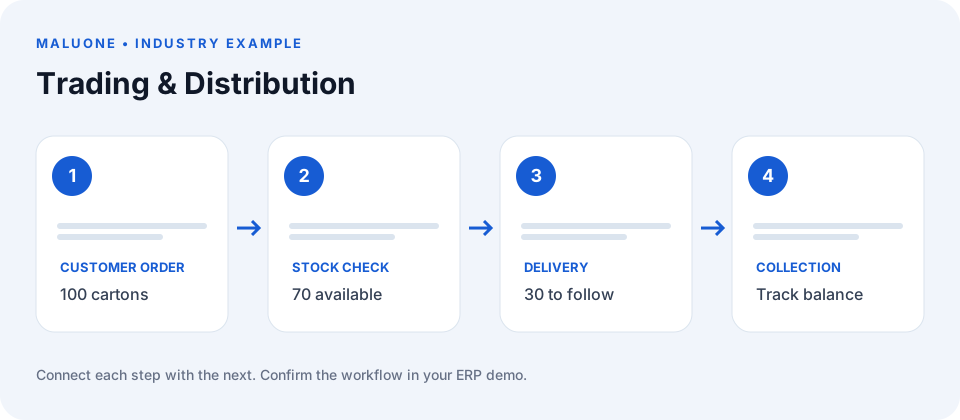
A distributor receives an order for 100 cartons. Only 70 are available. The team agrees a partial delivery, arranges the remaining 30 and tracks the unpaid invoice balance. Use this scenario to explore the sales, warehouse and finance handover in your demo.
Consequence: The customer expects 100 cartons while the warehouse can dispatch only 70.
Solution: Confirm quantities and delivery dates before committing; record any partial delivery agreement.
Consequence: A quantity entered in the wrong unit changes stock balances and pricing.
Solution: Agree the stocking and selling units and verify conversion quantities on each document.
Consequence: Sales appear complete while customer balances remain unpaid.
Solution: Review outstanding invoices and record receipts against the correct customer documents.
Use these illustrative cases to evaluate the workflow with the demonstration team. Confirm the available screens, controls and configuration for your scope.
A distributor accepts 100 cartons at 500,000 LAK each. It delivers and invoices 70 under the agreed terms, giving a 35 million invoice. The customer pays 20 million: 15 million remains on that invoice, while 30 cartons remain undelivered. Separate supply follow-up from collection follow-up. Figures exclude tax and other adjustments.
Read the visual: compare each document or stage separately, then follow the reconciliation shown beside it.
Keep the remaining delivery commitment visible
35m − 20m = 15m unpaid
Sales confirms the order, unit, price and partial-delivery agreement.
The buyer arranges the shortage and the warehouse records actual dispatch, receipt and any transit differences.
Finance reconciles invoices, receipts and credits while sales follows the remaining commitment.
The shipment may reach the wrong branch or incur unagreed charges.
Confirm the revised delivery instruction and responsibilities before dispatch.
A backorder date becomes an unsupported promise.
Review the shortage with purchasing, agree a new customer date and keep the remaining commitment visible.
Stock and the customer balance may be corrected independently.
Link return evidence to the original delivery and review condition, replacement and any approved credit together.
Sales, Purchasing, Inventory and Finance; confirm how their document references connect.
Outstanding orders, overdue supply, warehouse movements and customer balances for the same cutoff.
Agree carton conversions, warehouses, price approvals, delivery evidence and collection ownership.
Agree the results and any limitations in the implementation scope before launch.
Bring sample documents and one difficult exception. We can use these to discuss required modules, setup, responsibilities and acceptance criteria.
See the implementation approach →
Request a Trading & Distribution Demo